Scaling Information Literacy Through Embedded Learning Design
Course integrated digital learning, SME collaboration, performance support, and assessment.
Read case study 01Instructional design / Learning experiences
I’m Maria Ruelas. I design learning experiences that help people find their footing, practice new skills, and put knowledge to work.
Explore selected work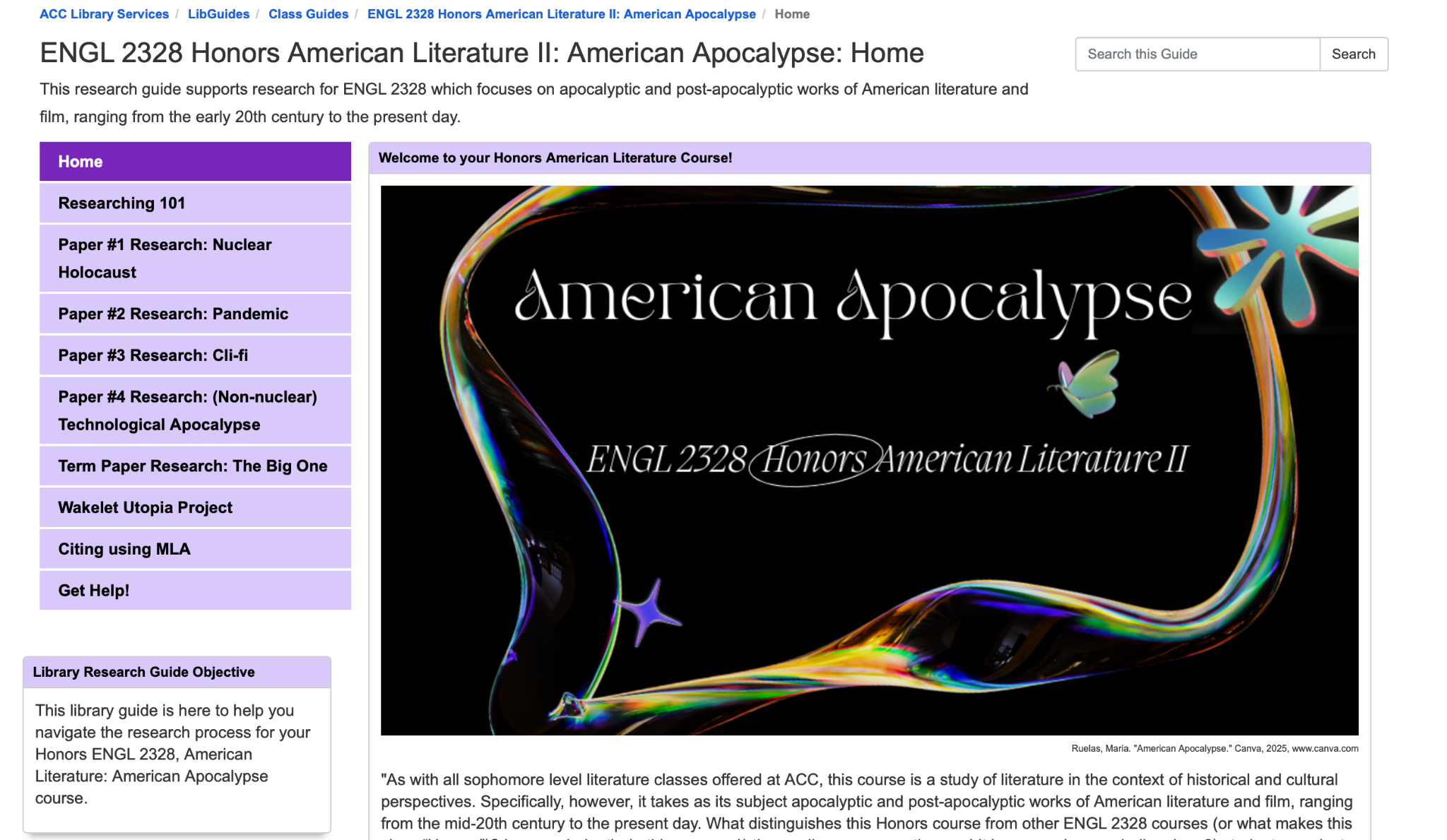
01 / Flagship projects
Four case studies connect needs analysis and stakeholder collaboration to scalable solutions, assessment, and implementation. Each explains the design rationale and connects the work to documented results.
Course integrated digital learning, SME collaboration, performance support, and assessment.
Read case study 01A connected system of consultation, practice, resource evaluation, and implementation support.
Read case study 02Program design, cross unit partnerships, assessment planning, and funded implementation.
Read case study 03Portfolio review, content governance, issue triage, and accessibility quality assurance.
Read case study 04Flagship case study 01
An assignment aligned learning system spanning multiple courses and delivery contexts.
Learners must find, evaluate, and use evidence while navigating unfamiliar research systems. Support has to fit different assignments and remain available beyond a scheduled session.
I designed course research guides and asynchronous instruction, collaborated with faculty subject matter experts, and developed the EDUC 1300 library resources video and quiz. I contributed course support across English, government, student success, and anthropology.
College learners and course instructors at Austin Community College (ACC). EDUC 1300 is a college success course. Faculty partners supplied the assignment context; Library Services supplied research expertise.
Faculty consultation shaped the course context, including an EDUC 1300 design brainstorming meeting on January 30, 2026 and review of asynchronous government materials. The Honors literature guide organizes support around actual assignments. Course learning objectives informed the guides updated for Fall 2026.
A set of reusable course guides, videos, and assessments, aligned to the course context. The Honors ENGL 2328 guide connects research topics, database walkthroughs, MLA citation, and contacts in one environment. EDUC 1300 combines an Introduction to Library Resources Panopto video with three knowledge checks.
Seven documented asynchronous cohorts include 54, 25, 15, 22, 45, 44, and 36 students, totaling 241 reported student instances from October 2025 through September 2026. Students may overlap across cohorts. EDUC 1300 implementation was reported for 22 students.
The EDUC 1300 quiz summary records 19 users, each with 3 questions and 3 correct answers: 57/57 recorded responses correct (100%). The three knowledge checks cover library resources, information evaluation, and asking a librarian.
Course specific asynchronous resources were delivered across multiple disciplines. The ENGL 2328 Honors and GOVT 2306 guides were updated and published for Fall 2026.
I invited faculty revisions after reviewing the government materials and updated guides for subsequent semesters. This approach keeps reusable resources aligned with current assignments. Future evaluation can connect knowledge checks to authentic source selection and search decisions in student work.
Evidence: Portfolio Evidence Bank, September 2025 through September 2026; EDUC 1300 Quiz User Summary Results, exported October 5, 2026. Recorded quiz activity spans February 13 through April 11, 2026.
Back to flagship projectsFlagship case study 02
Faculty enablement through open educational resources (OER), practical guidance, and a shared support workflow.
Faculty need more than lists of free materials. They must judge course fit, licensing, adaptation, and implementation, often when no single open textbook meets their requirements.
I provided faculty consultations, developed resource and licensing guidance, co-facilitated a Creative Commons/OER workshop, and created the support/activity tracker. I assumed the OER Librarian specialist role on August 17, 2026; workshop work was coauthored with Laura Tadena.
Course instructors, faculty librarians, Library Services, and repository partners. Requests in the supplied tracker relate to Fashion Design and Merchandising, Communication, and Accounting, as well as a copyright inquiry routed through Library Services.
The tracker captures request source, support type, course context, format, effort, outcomes, adoption status, and follow-up. Its four September records show different needs: fashion resource discovery and evaluation, copyright referral, communication resource consultation, and textbook entry guidance. The fashion request covers four course numbers.
A developing faculty support model that connects awareness, discovery, evaluation, licensing, and implementation guidance. Performance support includes a visual license reference, OER overview, resource evaluation guidance, and a workshop plan. OERTX Hub training supports repository work.
4 support records dated September 2, 9, 23, and 30, 2026. Two requests entered through faculty librarians, one through classroom faculty, and one through another route. Support formats recorded include email, Zoom/Google Meet, and phone.
The fashion record names FSHN 2303, 2320, 1311, and 2309 and records 2–4 hours of support. The Accounting record records less than 15 minutes. Two records identify a need for follow-up, supporting continuity across consultations.
Creative Commons certification, workshop delivery, tracker creation, and OERTX repository training established the expertise, reusable resources, and tracking infrastructure for the faculty support model.
The tracker supports a continuing consultation workflow by capturing needs, support provided, outcomes, and next steps. Its structured fields create a foundation for reviewing demand and refining services. Workshop resource plans and reflections provide a framework for evaluating decision quality and readiness.
Evidence: Portfolio Evidence Bank; OER Support & Activity Tracker AY-2026, four September 2026 records; existing workshop and reference artifacts.
Back to flagship projectsFlagship case study 03
A funded research recognition initiative designed through collaboration, assessment planning, and reusable implementation assets.
Strong student research needs visible recognition and a consistent way to evaluate the research process. A new initiative also requires funding, stakeholder alignment, and a practical launch pathway.
I participated in proposal development, co-pitched the initiative, and contributed communication, instructional assets, partner outreach, and rubric development as part of a collaborative team.
Student researchers, faculty librarians, the Faculty Center for Learning Innovation (FCLI), Marketing, and Belonging Centers, which support student identity and community. Partnership activity included the AAPI director and discussion of a Chinese course final project.
Proposal development began in September 2025. An invitation from FCLI leaders led to the March 2026 Spark Tank submission. Subsequent work addressed promotion, classroom integration, partner relevance, and rubric development.
A collaborative Library Research Award initiative supported by an innovation proposal, a funded pitch, approved promotional material, reusable instructional slides, partnership discussions, and rubric development. The work moved from proposal to funded launch preparation.
$2,500 in competitive institutional funding secured through the co-pitch on April 3, 2026.
March 2026 proposal submission; August faculty librarian communication, Marketing approval of a flyer, and reusable instructional slides; September Belonging Centers pitch preparation, AAPI partnership meeting, and continued rubric development.
The initiative connects institutional recognition with research and information literacy, supported by funding, communication assets, and cross unit partnership development.
The work progressed from a funded proposal to materials and partner conversations for implementation. Developing reusable assets alongside the assessment approach helped connect promotion, instruction, and program delivery. Future evaluation can examine participation, scoring consistency, and participant reflections.
Evidence: Monthly reports: September 2025, March and April 2026, and August/September 2026.
Back to flagship projectsFlagship case study 04
A repeatable review of published learning resources with documented issue categories and ownership constraints.
Published digital research resources must remain usable across learner needs. Issues can occur in local content, linked files, and third party database text, requiring review at portfolio scale and clear remediation ownership.
I completed the WAVE accessibility inventory project covering 19 published library guides in February 2026. The Composition and Literary Studies inventory documents page level review findings and notes for follow-up.
Students using digital research guides, subject faculty, content owners, Library Services, and platform or database providers responsible for content outside my editing control.
The inventory records page title, URL, publication status, relevance, a reported WAVE score, alerts, and notes. All eight listed pages are published and marked “Keep.” Findings distinguish locally editable content from third party database text requiring provider coordination.
A WAVE based accessibility inventory and content review identifies book cover alternative text, a PDF link, cover imagery, and third party database text as areas for attention. The inventory organizes findings for targeted follow-up.
The broader February 2026 project reviewed 19 published library guides. The English/Composition and Literary Studies inventory provides a detailed view of eight pages within one guide.
The eight page entries contain 42 recorded automated alerts. Journal Articles & Literary Criticism accounts for 27; Books & eBooks for 9; Writing & Grammar for 3; three other pages total 3. Six of eight pages have alerts. Recorded scores range from 9.5/10 to 10/10.
The inventory captures issue categories and editing ownership, creating a baseline for prioritizing local content updates and coordinating issues in third party content.
The inventory creates a baseline for continuous quality improvement. Future review can connect each finding to an owner, action, and retest, alongside manual keyboard and assistive technology checks.
Evidence: Portfolio Evidence Bank, February 2026 report; LibGuides Inventory Accessibility, Ruelas Maria, CLS. Alert total is calculated from the eight supplied rows.
Back to flagship projectsSupporting design examples
Selected original work provides a closer look at instructional decisions and collaboration.
Supporting example / Faculty development
A Hands-On Introduction to Creative Commons for Teaching with OERs
Faculty need to make decisions about using and adapting teaching materials. Knowing license names is only part of the task; the workshop asks participants to connect permissions to an actual teaching purpose.
The plan uses the Transparency in Learning and Teaching (TILT) framework to make the purpose, task, and criteria for success explicit. A sequence of short challenges prepares participants to find a resource, explain whether it fits their intended use, and draft an attribution.
Realistic teaching scenarios make the content relevant to adult learners. Choosing a resource for their own course gives participants an immediate application. Peer review asks them to explain a decision, making their reasoning visible.
Can the participant explain whether a resource’s license fits the intended teaching use?
The CC Resource Plan collects a resource, license, attribution, intended use, and rationale.
Before-and-after confidence ratings and an exit reflection surface perceived readiness and next steps.
The workshop plan connects realistic teaching decisions to an applied resource plan, peer review, confidence ratings, and reflection.
Supporting example / Digital learning support
Honors ENGL 2328: American Literature II — American Apocalypse
Research in an Honors literature course requires students to move between an assignment, a developing question, and suitable sources. Help needs to be available while they are doing that work.
The guide organizes support around the course’s research assignments: nuclear holocaust, pandemic, climate fiction, technological apocalypse, and a term paper. Researching 101 and MLA citation support provide reusable foundations.
Assignment-based navigation connects the resource to the learner’s immediate task. Linked database walkthroughs support procedural practice. Clear contacts distinguish questions for the course professor from questions for a librarian.
My assessment lens looks for a student’s ability to refine a research question, select an appropriate source type, construct and revise a search, evaluate evidence, and cite sources. These observable actions provide a practical way to evaluate the skills the guide supports.
The guide brings assignment context, research procedures, citation support, and contacts into a reusable learning resource.
Supporting example / Collaboration & facilitation
Better Together: Faculty and Librarian Partnerships for Student Success
The session addresses practical, cognitive, and emotional barriers to research support, including unfamiliar systems and uncertainty about asking for help.
Four models make collaboration tangible: the Launch Pad, the Deep Dive, the Assignment Architect, and the Embedded Partner. Examples connect each model to a different level of course support.
An opening participation activity connects the topic to attendees’ own experiences. The closing think-pair-share asks them to identify a moment when students struggle and consider how a librarian could help. The session ends with a concrete invitation to choose a strategy and a partner.
Professional learning facilitation, visual organization of a complex topic, stakeholder partnership, and a prompt that connects discussion to action.
The session uses research background, collaboration models, and a closing action prompt to help participants plan a relevant faculty and librarian partnership.
02 / Assessment & design approach
I connect broad learning goals to actions that can be observed in student work, a conversation, or a practice activity. These five areas guide what I look for.
Learning goal: Understand research as an iterative process, refine a question, and select sources that fit an information need.
Look for: A student explains what an assignment asks, narrows or broadens a topic, and justifies a source choice.
Learning goal: Locate information strategically and adapt when a search does not work.
Look for: Keywords and synonyms, purposeful use of Boolean operators and filters, and a revised search after reviewing results.
Learning goal: Evaluate sources, interpret evidence, and identify bias.
Look for: Application of SIFT, CRAAP, or lateral reading; an explanation of a chart’s claim; identification of missing perspectives; and recognition that AI-generated content needs verification.
Learning goal: Build original work from multiple sources while recognizing personal assumptions.
Look for: An original claim supported by more than one source, consideration of differing viewpoints, and reflection on how one’s perspective affects interpretation.
Learning goal: Use information ethically, cite accurately, and attribute human and AI contributions transparently.
Look for: Correct citation choices, recognition of when attribution is needed, attention to reuse permissions, and disclosure of AI use.
AI as a thought partner
I use ChatGPT and Canva AI as thought partners when developing learning materials. I apply my evaluation skills to their suggestions, make the final decisions, and take responsibility for the finished output.
03 / Visual communication
Selected reference materials and instructional writing show how I organize information for learners. Open each original sample for a closer look.
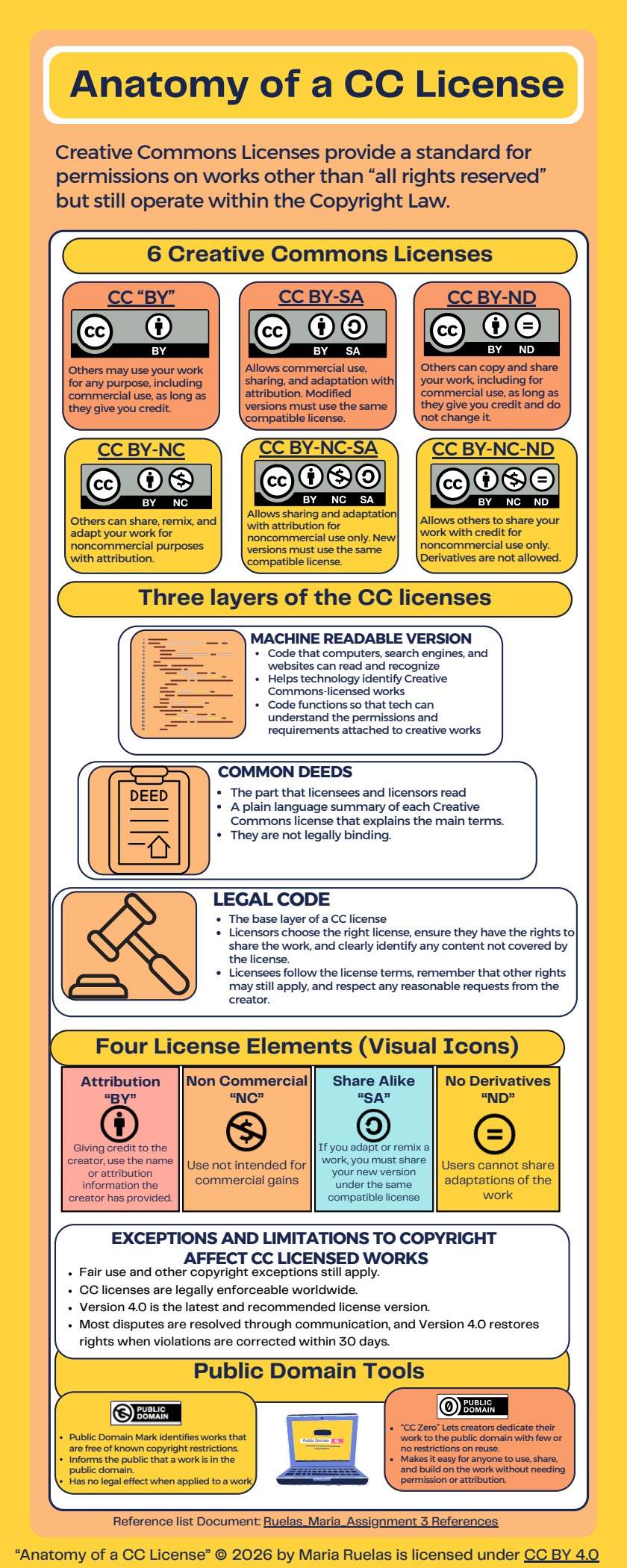
Reference design
A visual hierarchy brings license elements, layers, and public domain tools into one reference.
View original (PDF)Maria Ruelas, 2026 · CC BY 4.0
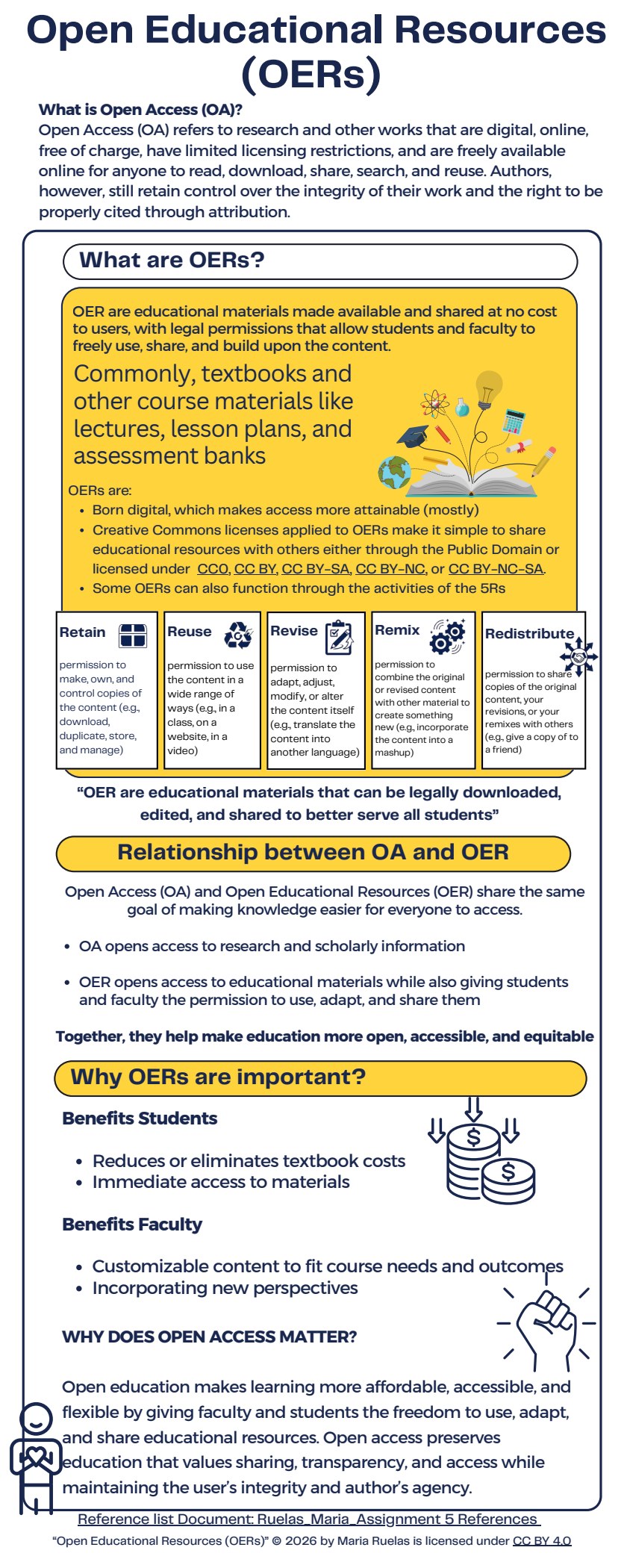
Information design
An overview of open access, open educational resources, and the five reuse permissions.
View original (PDF)Maria Ruelas, 2026 · CC BY 4.0
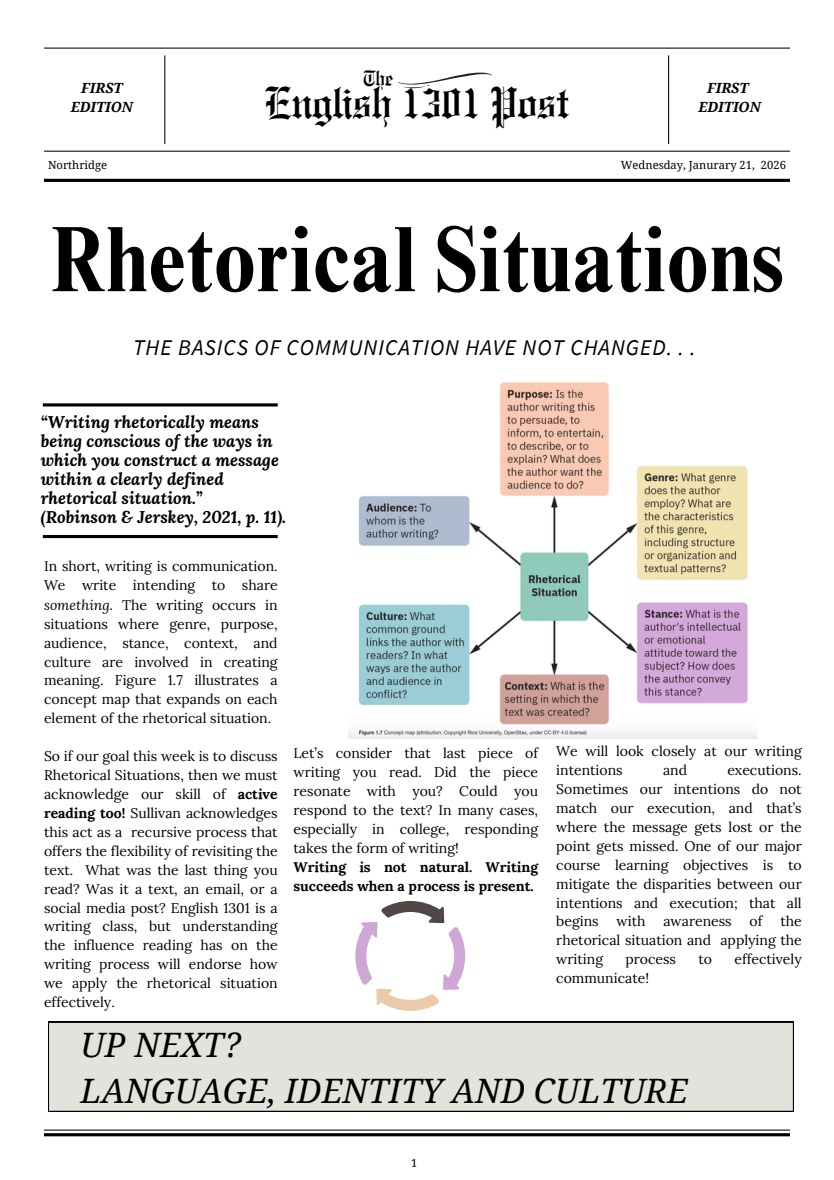
Instructional writing
A newspaper-inspired course introduction connects reading, writing, and rhetorical situations.
View original (PDF)English Composition I · January 2026
04 / About Maria
I bring together curriculum design, information literacy, and teaching to create learning experiences grounded in the learner’s task.
My work at Austin Community College spans faculty librarianship, English composition instruction, and open educational resources. I partner with faculty and academic colleagues to connect learning needs, useful resources, and assessment.
I have led work on information literacy instruction best practices across Library Services and served on ACC’s Distance Education Committee.
Connect on LinkedIn2023–present / Austin Community College
2025–present / Austin Community College
2018–2022 / Austin Community College
University of Texas Rio Grande Valley · 2025
San José State University · 2022
Texas State University · 2018